
AI agents

Agents that do the admin, not chatbots that talk about it.


Our agents work inside the platform, on your records. They run on a schedule, act on what arrives, and leave a trail you can check. Anything that touches money or a customer waits for a person to approve it.

Enquiry agent

Replies to website and email enquiries quickly, at any hour, using answers your team has approved.

  • Asks the right questions: property, symptoms, postcode, scope
  • Offers slots from the live diary
  • Follows up when an enquiry goes quiet
  • Won’t make things up. Hands over to a person when unsure

“Is this a new enquiry or a return visit?”
Inbox agent

Reads the shared mailbox so nobody has to sort it by hand.

  • Sorts insurer, supplier and customer emails
  • Pulls invoices, PO numbers and claim references out of attachments
  • Files each one against the right job, staged for approval
  • Keeps a full history of what it did and why

“Adjuster report received, filed to the job.”

Ask your data

Plain-English questions answered from your jobs, timesheets and documents.

  • Answers across job records, surveys and files
  • Shows the source it used, so you can check it
  • Upload a document and ask about it
  • Keeps threads you can come back to

“Which jobs ran over last year?”

Built for you

Custom agents and connectors

If a task is repetitive and rule-based, an agent can usually take it on. If a system you rely on has no way to connect, we build the connector.

  • Turning survey notes and photos into a draft quote for a person to check
  • Chasing outstanding insurer payments and customer sign-offs
  • Linking your accounts package and the other tools you keep, both ways where they allow it
  • Pulling data from systems with no API, the way a person would, on a schedule

Analytics

See which jobs make money, and where the next ones will come from.


Once time, materials and jobs sit in one system, the numbers come for free. Nobody has to build a report at month-end. These run continuously on the data the platform is already collecting.

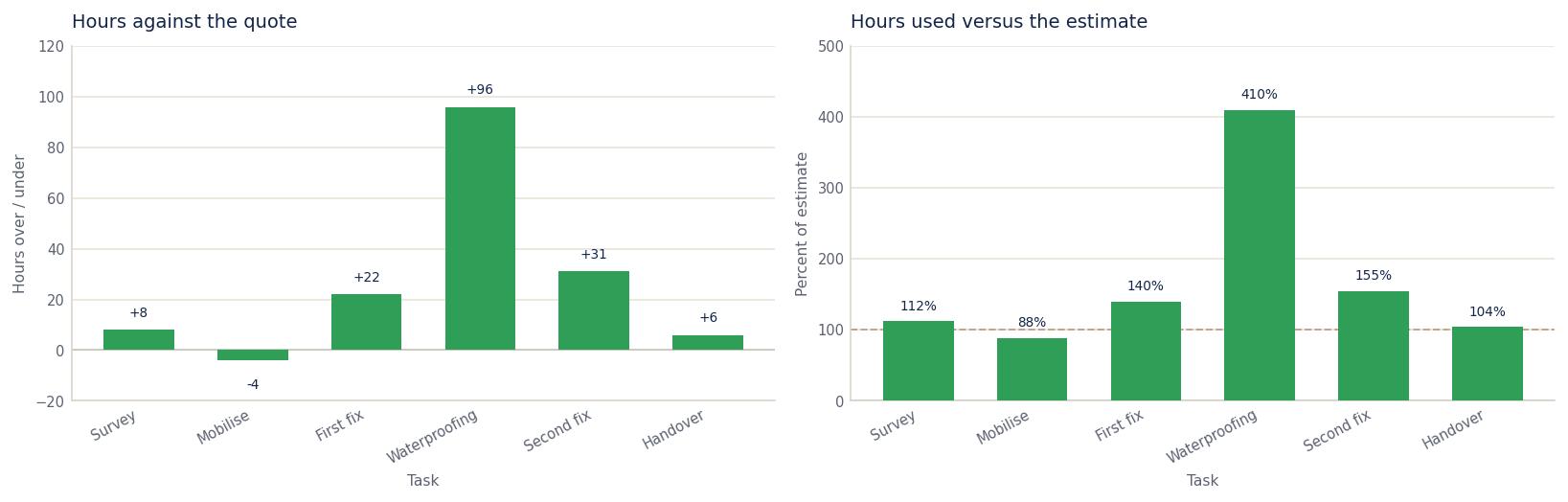
Example charts of hours over or under the quote, and hours used as a percent of the estimate. Waterproofing is the task running far over.
Quoted versus actual, by task. An example, not a client’s books. Waterproofing is using about four times the hours that were quoted. That is worth knowing in week three, not at the final invoice.

Job costing, live

Quoted against actual for labour and materials on every job, flagged as soon as it starts to drift.

Margin by job type

Which work pays best, so the next quote is priced from evidence rather than habit.

Demand by area

Where enquiries come from and which areas are rising, so marketing and crews go where the work is.

Seasonal forecasting

Weather, season and past years show the busy months coming, so you can staff for them.

Crew utilisation

Hours by person, trade and job, so you can see who is stretched and where time goes.

Enquiry to job

How many enquiries turn into surveys, quotes and paid work, and where they drop off.

Outliers flagged

Unusual costs, hours or supplier invoices picked out automatically for a person to look at.

Suggested actions

Agents point to the specific step that improves the number, not just the number itself.

Connectors

We build the connections your software doesn’t come with.


Whichever route applies, incoming data waits in a staging area for a person to approve before anything is written to your books.

Read and write API

Two-way sync

Where a tool lets us read and write, the platform pulls data in and pushes updates back, so both stay in step.

Available for a good share of tools

Read-only API

Automatic intake

Where a tool only lets data out, we pull it in on a schedule, so nothing is exported or re-keyed by hand.

Available for most tools

No API at all

A custom connector we build

For systems with no way in, we build our own connector that works the screens the way a person would, on a schedule.

Our speciality

Next

Four phases, starting with how you already work.

A working session first. Agents switched on where they save time.

How we work